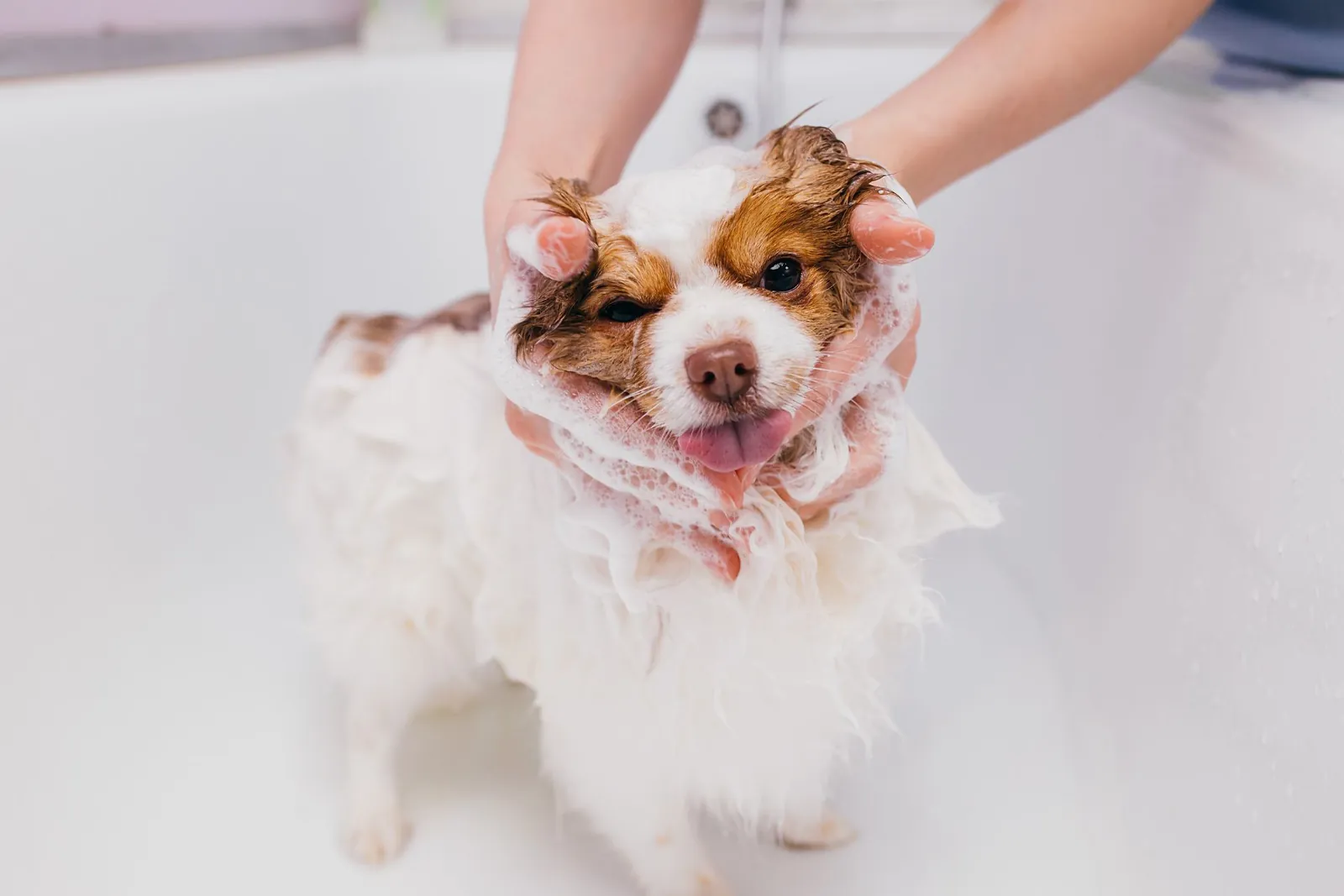
How Often Should a Long-Haired Dog Be Groomed? A Clear Answer

"How long can we go between grooms?" is the question Lisa hears most from owners of long-haired dogs. The honest answer is: probably not as long as you hope. Long coats look effortless when they are freshly groomed. Underneath, they are working against you every day, catching loose hair, tangling with every scratch and roll, and slowly knotting close to the skin.
Here is a clear guide to how often long-haired dogs should be groomed, organized by the type of long coat your dog has.
Not all long hair is the same
"Long-haired" covers very different coats, and each one needs a different schedule.
Continuously growing coats
Examples: Poodles, Doodles, Shih Tzus, Bichons, Maltese, Yorkies, Havanese, Lhasa Apsos.
This hair keeps growing and does not shed much. Loose hair gets trapped in the coat instead of falling out. That is what makes these breeds so prone to mats.
Long double coats
Examples: Golden Retrievers, Collies, Shelties, Bernese Mountain Dogs, long-coated German Shepherds, Pomeranians.
These dogs have a dense undercoat that sheds heavily. Their coat grows to a set length, but shed undercoat packs in and mats, especially behind the ears and in the "pants."
Silky coats
Examples: Cocker Spaniels, Setters, Cavalier King Charles Spaniels.
Fine, silky hair on the ears, chest and legs. It tangles easily and catches burrs and foxtails.
The schedule, by coat type
Continuously growing coats: 4 to 8 weeks
- No longer than 6 to 8 weeks for a short to medium pet trim.
- Every 4 to 6 weeks if you keep the coat longer, or if your dog is very active.
- Puppies: start early with short, gentle visits so they get used to grooming.
A regular full haircut keeps the coat at a length you can maintain at home.
Long double coats: 4 to 8 weeks
- Every 4 to 6 weeks for most, with an extra de-shedding visit during heavy spring and fall sheds.
- Up to 8 weeks for dogs with less undercoat or owners who brush often.
A high-velocity blowout moves out the loose undercoat brushing misses. Remember: these coats should not be shaved. Tidying the feet, ears, sanitary area and feathering is fine.
Silky coats: 4 to 6 weeks
- Every 4 to 6 weeks to keep ears, chest and legs tidy and tangle-free.
- More often in spring if your dog is outdoors a lot, since foxtails love silky feathering.
What happens when you wait too long
This is the part nobody likes to hear, but it is worth understanding.
- Weeks 1 to 4: loose hair starts collecting near the skin. Small tangles form in friction areas.
- Weeks 5 to 8: tangles grab more hair and tighten. The top of the coat can still look fine.
- Beyond 8 weeks: mats join together. In bad cases the coat becomes a solid layer close to the skin, which traps moisture, pulls on the skin and can hide irritation.
Once a coat reaches that stage, brushing it out would be painful and stressful for the dog. The kind, safe option is usually to clip it short and start fresh. Lisa will always explain this before doing it. The coat grows back, and a regular schedule from there keeps it from happening again.
Signs your dog is overdue
- A metal comb will not go through to the skin in several spots.
- Hair is covering the eyes or growing into them.
- Hair between the paw pads is long enough that your dog slips on tile.
- There is a smell even though your dog had a bath recently.
- The coat around the rear is soiled or matted.
- Your dog is scratching at certain spots, often where a mat is pulling.
Things that shorten the ideal interval
- Swimming and bathing at home. Water tightens tangles if the coat is not fully dried.
- Harnesses and sweaters. They rub the coat and cause matting underneath.
- Active outdoor life. Rolling, digging and brush walks all add tangles and debris.
- Foxtail season. In the Inland Empire, spring foxtails cling to long coats and work their way into paws and ears.
- Coat change. Doodle and Poodle puppies go through a coat change, often around their first year, when mats form especially fast.
Home care that stretches the time between grooms
- Brush down to the skin a few times a week with a slicker, then check with a metal comb.
- Pay extra attention to ears, armpits, collar line, back legs and tail.
- Take harnesses off at home.
- After baths or swims, dry the coat completely.
- Check paws and ears after walks in spring.
Even with great home care, long-haired dogs still need professional grooming on a regular schedule. Home brushing keeps the coat healthy between visits. It does not replace them.
Choosing a length you can live with
If you love a long, fluffy look but cannot brush every few days, a slightly shorter trim might be the happiest choice for you and your dog. Talk to Lisa about your routine. A coat that is a little shorter but always comfortable beats a long coat that ends up shaved every few months.
Serving long-haired dogs across the area
Lisa grooms dogs of all breeds and sizes in Chino, Chino Hills, Diamond Bar, Phillips Ranch, Upland, Claremont, Ontario and Eastvale.
Set up a schedule
The easiest way to stay on track is to book the next visit at the end of each groom. Fill out the quote form to get started, and Lisa will help you pick a schedule that fits your dog's coat.
Quick Answers
How often should a Shih Tzu or Doodle be groomed?
No longer than 6 to 8 weeks between professional grooms, and every 4 to 6 weeks if you keep the coat long.
Why did my groomer have to shave my dog?
When a coat is matted close to the skin, brushing it out can be painful. Clipping it short is often the kindest option, and the coat grows back.
Can I shave my Golden Retriever to reduce shedding?
It is generally best not to shave a double coat. A de-shed and blowout removes loose undercoat without changing how the coat grows.